
Adolescent and Adult Cleft and Craniofacial Care
The Advanced Head and Neck, Cranial / Orbital / Maxillofacial Surgery Program at Scripps Prebys Cancer Center provides specialized surgical care for adolescents and adults living with cleft lip, cleft palate, and craniofacial differences. While much of cleft and craniofacial surgery is performed during infancy and early childhood, many patients require continued surgical management as they mature. Our program is specifically designed to address the complex functional and aesthetic needs that emerge during adolescence and persist into adulthood.
Under the direction of Dr. Ravi Garg, who brings fellowship-trained expertise in complex craniomaxillofacial surgery and state-of-the-art computer-aided design and manufacturing (CAD/CAM) technology, our team delivers precision-driven surgical care that restores both form and function. Every treatment plan is developed through close multidisciplinary collaboration to ensure each patient receives comprehensive, individualized care.
Why Specialized Adolescent and Adult Cleft Care Matters
Cleft lip and cleft palate are among the most common congenital conditions, affecting approximately 1 in 700 births. While initial repairs are typically performed in infancy, the craniofacial skeleton continues to grow and change throughout childhood and adolescence. As a result, many patients who underwent early intervention will benefit from additional surgical procedures to address functional problems, correct skeletal discrepancies that become apparent with facial growth, or improve aesthetic outcomes.
Adults with cleft and craniofacial conditions may also present with concerns that were not fully addressed during childhood, or they may experience secondary issues related to earlier surgical interventions. Some adults are seeking care for the first time, whether due to limited access to treatment earlier in life or because they are now ready to pursue surgical correction. Our program recognizes that the needs of adolescent and adult cleft patients are distinct from those of younger children and require a specialized approach grounded in advanced craniomaxillofacial surgical technique.
Conditions We Treat
Our cleft and craniofacial program provides surgical management for a wide range of conditions affecting adolescents and adults, including:
Cleft-Related Conditions
- Cleft Lip Revision Surgery. Secondary cleft lip repair addresses residual scarring, asymmetry of the lip and nose, and soft tissue irregularities that persist from primary repair. Our approach utilizes advanced reconstructive techniques to improve both the appearance and symmetry of the lip and nasal structures, with particular attention to restoring natural contour and proportion.
- Cleft Palate and Velopharyngeal Insufficiency. Some adolescent and adult patients experience persistent velopharyngeal insufficiency (VPI), a condition in which the soft palate does not adequately close against the back wall of the throat during speech and swallowing. This can result in hypernasal speech, nasal air emission, and difficulty with articulation. Surgical management may include palatal revision, autologous fat transfer, pharyngeal flap procedures, or sphincter pharyngoplasty, coordinated with speech-language pathology assessment to achieve optimal outcomes.
- Alveolar Cleft Bone Grafting. Patients with cleft palate frequently have a bony defect in the alveolar ridge (the bone that supports the teeth). Secondary alveolar bone grafting stabilizes the dental arch, provides bone support for tooth eruption or future dental implant placement, and helps close any remaining oronasal fistulae. This procedure is commonly performed in late childhood or early adolescence but may also be indicated in adult patients who did not receive earlier grafting.
- Oronasal Fistula Repair. An oronasal fistula is an abnormal opening between the oral and nasal cavities that can result from incomplete palatal healing or prior surgical repair. Fistulae may cause nasal regurgitation of food and liquids, affect speech quality, and contribute to chronic nasal symptoms. Our team employs multilayer soft tissue repair techniques as well as flap reconstructive procedures to achieve durable closure.
Craniofacial Skeletal Conditions
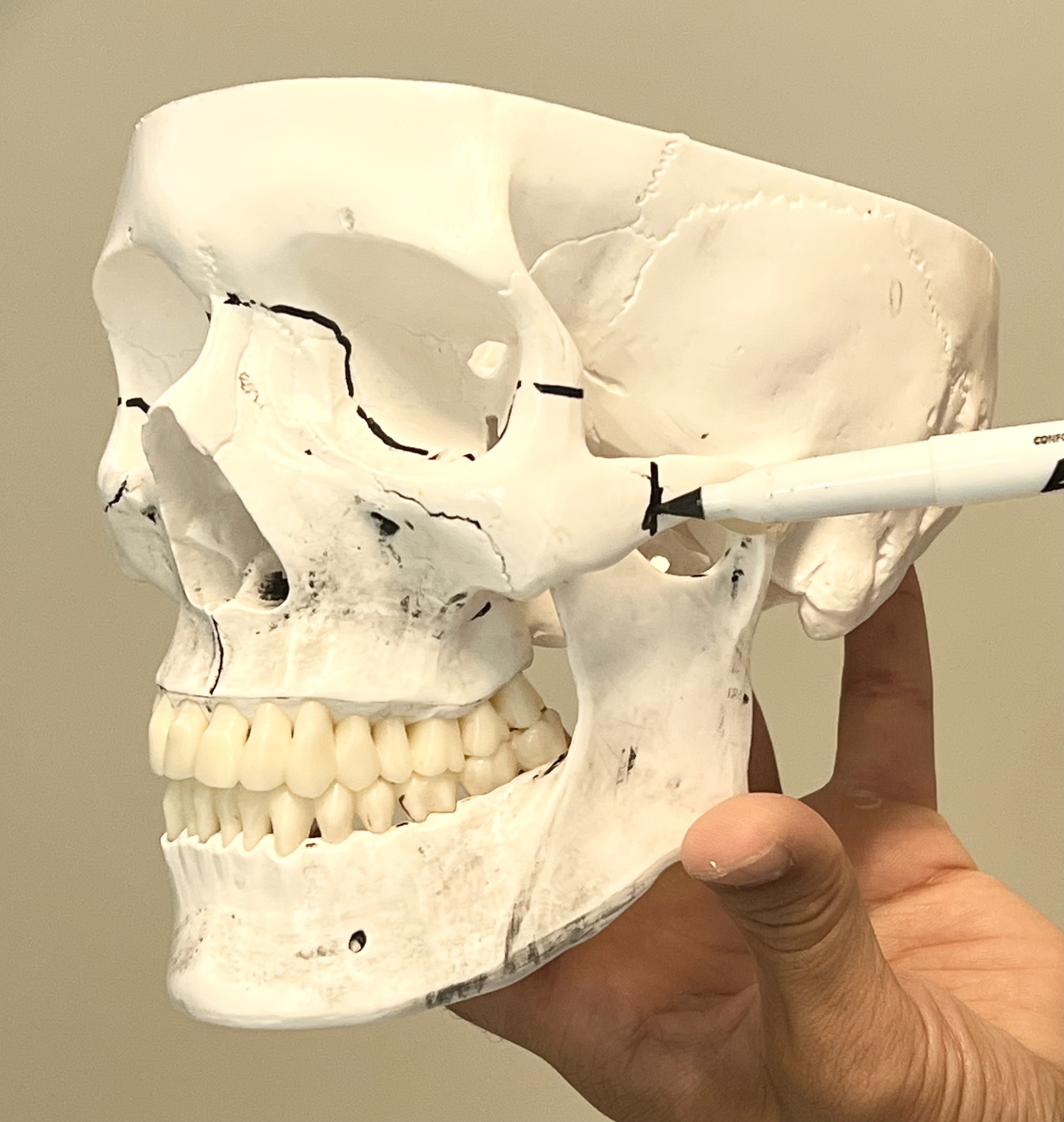
- Orthognathic (Corrective Jaw) Surgery for Cleft Patients. Midface deficiency is one of the most common skeletal consequences of cleft lip and palate, developing as a result of both the original cleft anatomy and the effects of prior surgical repair on facial growth. Patients frequently present with maxillary retrusion (an underdeveloped upper jaw), resulting in a Class III malocclusion, difficulty chewing, obstructive breathing patterns, and an imbalanced facial profile. Our program utilizes computer aided design and manufacturing to perform precise Le Fort I osteotomy, bilateral sagittal split osteotomy, and genioplasty procedures - individually or in combination - to restore proper jaw alignment and facial harmony.
- Craniofacial Reconstruction. Complex craniofacial conditions such as craniosynostosis, hemifacial microsomia, Treacher Collins syndrome, Crouzon syndrome, and other congenital or acquired craniofacial differences may require reconstructive surgery during adolescence or adulthood. These procedures address both functional deficits and skeletal asymmetries, and may involve repositioning of facial bones such as Le Fort 3 osteotomy, distraction osteogenesis, or microvascular free tissue transfer when soft tissue volume is insufficient.
- Cleft Rhinoplasty. The nasal difference associated with cleft lip is one of the most challenging aspects of cleft reconstruction. Cleft rhinoplasty addresses the characteristic asymmetry of the nasal tip, deviation of the nasal septum, and collapse or malposition of the lower lateral cartilages. Our surgical approach combines functional correction of the nasal airway with aesthetic refinement to achieve a balanced, natural result.
- Secondary Craniofacial Procedures. Patients with a history of craniofacial surgery may benefit from additional procedures as they reach skeletal maturity. These may include revision of prior reconstructions, bone grafting to augment deficient areas, hardware removal, or soft tissue refinement procedures to optimize long-term aesthetic and functional outcomes.
Advanced Surgical Planning and Technology
Cleft and craniofacial surgery demands extraordinary precision. Our program leverages the latest advances in computer-aided surgical planning to achieve outcomes that were not possible with conventional techniques alone.
Virtual Surgical Planning (VSP). Using high-resolution CT imaging, our surgical team creates detailed three-dimensional digital models of each patient's craniofacial anatomy. These virtual models allow us to simulate the planned surgical movements, evaluate multiple treatment scenarios, and determine the optimal repositioning of the facial skeleton before entering the operating room. This preoperative virtual rehearsal translates directly into improved surgical accuracy and predictability.
Computer-Aided Design and Manufacturing (CAD/CAM). Patient-specific surgical splints, cutting guides and/or fixation plates are digitally designed and 3D-printed based on the virtual surgical plan. These custom instruments ensure that the planned bone cuts and movements are executed with millimeter-level precision during surgery. For patients undergoing orthognathic surgery or craniofacial reconstruction, this technology reduces operative time, minimizes intraoperative variability, and delivers more consistent results.
Microvascular Reconstruction. When craniofacial defects require tissue that cannot be sourced locally, our team performs microvascular free tissue transfer to reconstruct bone and soft tissue deficits. Using microsurgical techniques, bone and tissue from donor sites such as the fibula, scapula, or radial forearm are transferred with their blood supply intact and precisely shaped to restore craniofacial form and function. This capability is particularly important for patients with large bony defects, extensive soft tissue loss, or craniofacial conditions that have not responded to conventional reconstruction.
A Multidisciplinary Approach
Effective cleft and craniofacial care extends well beyond the operating room. Our program at Scripps Prebys Cancer Center is built on the principle that the best outcomes are achieved when surgical expertise is integrated with the knowledge of multiple specialties working toward a common goal. Depending on each patient's needs, our team coordinates care with:
Orthodontics. Presurgical orthodontic preparation is essential for patients undergoing orthognathic surgery. Our surgeons work closely with orthodontists experienced in cleft care to ensure optimal dental alignment before and after surgical jaw repositioning.
Speech-Language Pathology. For patients with velopharyngeal insufficiency or speech difficulties related to their cleft anatomy, preoperative and postoperative speech evaluation helps guide surgical decision-making and track functional improvement.
Prosthodontics and Restorative Dentistry. Many cleft patients have missing, malformed, or malaligned teeth. Coordination with prosthodontists and restorative dentists ensures that dental rehabilitation - including implants, bridges, and prosthetic devices - is timed appropriately with surgical treatment.
Otolaryngology. Patients with cleft palate have an elevated incidence of middle ear disease and hearing difficulties. When indicated, our team coordinates with otolaryngology colleagues to address these concerns as part of the comprehensive treatment plan.
Psychology and Social Support. Living with a craniofacial difference can have a profound impact on self-esteem, social interaction, and psychological well-being - particularly during adolescence. We recognize the importance of addressing the emotional and psychosocial dimensions of craniofacial care and support referrals to experienced counselors and psychologists.
What to Expect
Every patient's journey begins with a comprehensive evaluation. During your initial consultation, our surgical team will review your medical and surgical history, perform a thorough clinical examination, and obtain advanced imaging as needed. We take the time to understand your goals and concerns, and we develop a detailed treatment plan that addresses both immediate needs and long-term outcomes.
For patients considering orthognathic surgery, the process typically begins with coordination between our surgical team and your orthodontist, followed by virtual surgical planning, the surgical procedure itself, and a structured postoperative recovery and follow-up protocol. The specific timeline and surgical approach vary based on the complexity of each case, and our team provides clear guidance at every step.
We understand that pursuing cleft or craniofacial surgery as an adolescent or adult involves unique considerations - from insurance coordination to scheduling around academic or professional commitments. Our staff is experienced in navigating these logistics and is committed to making the process as streamlined as possible.
Insurance Coordination
Cleft and craniofacial surgical procedures are generally considered medically necessary and are covered by most insurance plans. Our team has extensive experience working with insurance providers to obtain prior authorizations and help patients receive coverage when medically indicated. We encourage patients to contact our office early in the process so we can assist with insurance verification and pre-authorization.
Schedule a Consultation
If you or a family member is an adolescent or adult living with a cleft or craniofacial condition, the Advanced Head and Neck, Cranial / Orbital / Maxillofacial Surgery Program at Scripps Prebys Cancer Center is here to help. Contact our office to schedule a consultation and learn how our specialized surgical expertise can help you achieve the functional and aesthetic outcomes you deserve.